
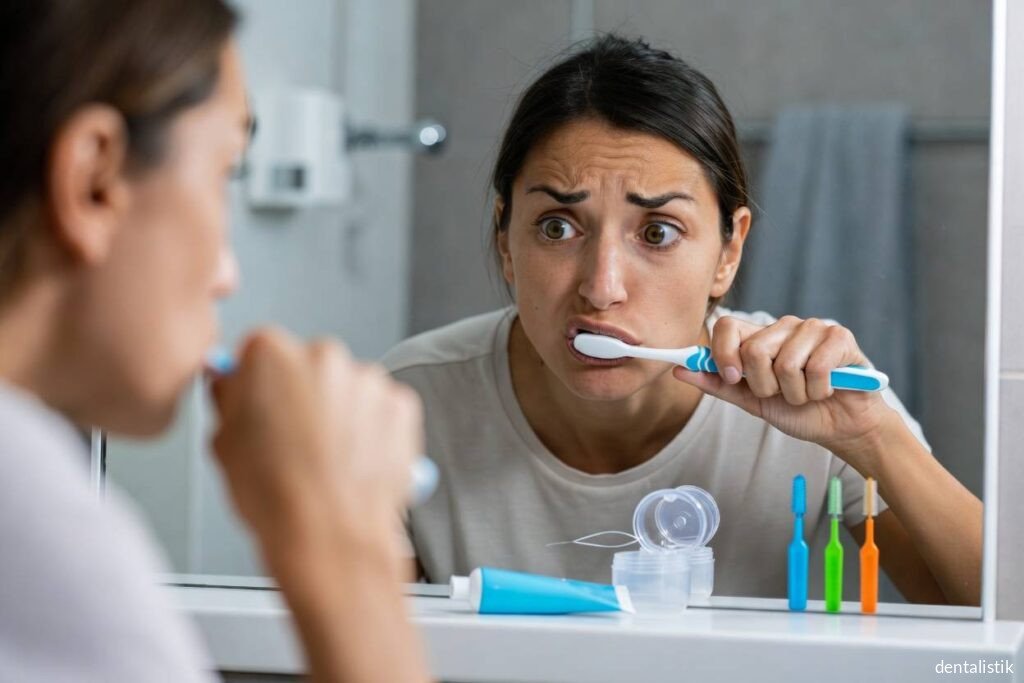
You brush your teeth morning and night, you pay attention to your technique, and when you go for your yearly check-up, you open wide thinking “this time it’s going to be perfect.”
And then the dentist says:
“I think there’s a little cavity starting here, between the teeth on the lower left. We’ll check it with a small X-ray.” “Ah, it’s not bad, but I can see a bit of tartar behind the lower front teeth, and also around the molars on the tongue and palate side. Do your gums bleed a little when you brush sometimes?”
And in your head you’re like: “What the hell is going on?!”
You leave the office feeling a bit lost: “But I brush twice a day, I do everything right… so why do I still have tartar, cavities, and irritated gums? What am I missing?”
Don’t worry, you’re not alone in this boat. 😅 Very often it’s not about lack of effort. It’s simply that even a well-used toothbrush can’t reach everywhere. There are little hidden spots where plaque and bacteria throw their own private party.
The good news? Adding these 3 essential tools to your routine can make a real difference.
1. Your Toothbrush: The Daily Foundation
You can choose between a manual toothbrush and an electric one.
Electric sonic toothbrushes (the ones that vibrate like crazy) are especially helpful if your manual brushing technique isn’t quite perfect yet. They’re more forgiving and often give better results when your hand movements aren’t 100% on point.
However, if you already have good technique with a manual brush, you don’t need to switch to electric — it already does a great job. Bottom line: the electric brush doesn’t remove “more” tartar by itself, but it’s more efficient when manual technique isn’t optimal.
Golden rule (never skip this): Always use soft bristles. Never medium or hard! Hard bristles can irritate your gums, wear down enamel, and even damage exposed roots, especially if your gums are thin. Soft bristles are gentle and very effective.
How to use it properly:
- Manual toothbrush: Use small back-and-forth movements combined with gentle circular motions, holding the brush at a 45-degree angle toward the gum line. It takes a little time to get the right feel — totally normal at first.
- Electric toothbrush: Let the brush do the work. You don’t need to scrub or make circles. Just guide the head so it stays in full contact with every tooth surface. Tilt it slightly to gently clean under the gum line — this part is very important.
Brush for 2 minutes, morning and night, covering all surfaces: front, back, and chewing sides.
At the end, lightly brush your tongue with back-and-forth strokes to remove some of the bacteria. You can also very gently brush your gums, moving from the gum toward the tooth (never the other way), to complete the cleaning without irritating them.
Quick tip: Change the head as soon as the bristles start going wild in every direction (every 3 months max).
2. Dental Floss: The Point-of-Contact Specialist
Dental floss cleans the contact points between each tooth — right where the teeth touch at the top.
It also dislodges plaque, bacteria, and tiny food particles stuck under that contact point, in the spaces the toothbrush bristles can’t reach.
When to prefer floss over interdental brushes? Always use it for the actual contact point. But if the space below that point is too tight for interdental brushes, then floss is the only tool that can clean there properly.
Ideally, floss once a day. When you pass the contact point you’ll often hear a little “click.” Then gently slide or lift the floss out from one side — always softly so you don’t irritate the gum.
3. Interdental Brushes: The Secret Weapon
Interdental brushes do not clean the contact point itself. Their real job is to clean everything underneath it: plaque, trapped food bits, and bacteria.
They work especially well between molars and premolars (where the most plaque builds up), but you should also use them on canines and incisors. In short — use them everywhere in your mouth!
The key detail: choosing the right size Start with the smallest, then move up until you feel a slight resistance (the bristles should rub nicely without forcing). Follow the 3F rule: Friction without Forcing or Floating.
Most mouths need 2 or 3 different sizes. This little detail makes all the difference.
The Best Order for a Truly Clean Mouth
- Brush for 2 minutes (including the quick tongue and gum pass at the end).
- Floss.
- Interdental brushes (everywhere).
- Quick final brush to polish everything.
The Ultimate Test: Your Tongue
When you’re finished, run your tongue over every surface of your teeth. If it feels smooth like glass → perfect! If it still feels a bit rough → go back over those spots.
Do this routine every day and you’ll quickly stop hearing “there’s still some tartar” at the dentist. Your gums will calm down, your breath will feel fresher, and your teeth will stay cleaner longer.
Are you already using interdental brushes? Do you struggle with sizes or have you found your perfect combo? What order do you follow in your routine?
Tell me in the comments — I read everything 😄