
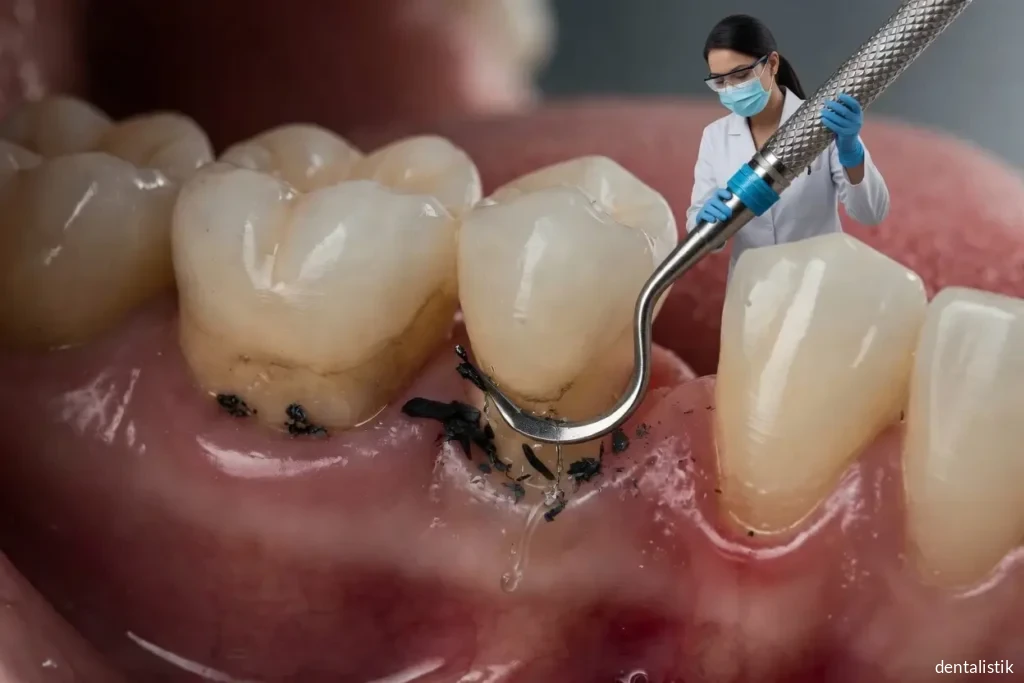
You just walked out of the dentist’s office, a bit dazed: your dentist mentioned periodontitis, gum recession, or even teeth starting to loosen… And bam, they hit you with “root planing” (or subgingival scaling, periodontal debridement – yeah, it sounds kinda like a wizard spell). You instantly think: “What the heck is that? Will it hurt? Is it gonna take forever?” Take a deep breath: it’s not open-heart surgery, just an extreme deep clean to stop the inflammation and get your gums back to real health.
Picture this: under your gums, bacteria are throwing a nonstop party. Your brush and floss can’t reach those hidden spots, so tartar and bugs cling to the roots, inflame everything. Result? Periodontal pockets form – those little gaps between gum and tooth where things get worse. And worse, the bone holding your teeth starts pulling back slowly.
Root planing is the big cleanup: kick out the party, calm the swelling, and halt the whole mess for good.
How does it actually go down?
The idea’s super straightforward: remove the tartar, plaque, and bacteria hiding under the gum, right on the roots. Once the root’s clean and smooth, gums can reattach as much as possible – basically, it seals things up and makes it way harder for junk to sneak back in.
The tools? Fine instruments that slide under the gum and fit perfectly to your root shapes:
- Special manual curettes for “planing” the root surface.
- Curved ultrasonic tips – precise, gentle, and barely rough on your roots.
For shallow pockets, sometimes no anesthesia at all. But if it’s sensitive or bone loss is bad, a quick local shot makes it comfy (like for a filling).
The treatment usually happens in 1 to 4 sessions (by mouth quadrants, like sections). Why split it? Lets you see progress live: gums turning pink, bleeding stopping, papillae coming back… And mostly, to check you’re nailing those interdental brushes and know how to use ’em – ’cause without them, the gains vanish fast!
INTERDENTAL BRUSHES ARE A MUST after this. You’re the one keeping it going long-term!
The real wins for your smile
This treatment delivers solid results and often flips the script:
- Stops inflammation and blocks (or slows way down) bone loss and loosening.
- Kills bleeding: gums pink, pretty, and chill.
- Boosts breath and comfort: bye to spots where tartar and food rot.
- Helps gums reattach → better stability and seal.
- Strengthens foundations: slightly wobbly teeth can “refirm” once swelling’s gone.
- Often skips heavier stuff (surgery, bone grafts, implants…) if caught early.
It’s a total game-changer for keeping your teeth forever.
But let’s be real: the downsides
No magic fix, here’s the truth:
- Gum recession possible: healthy gums pull back a bit (often 3-4 mm from bone), teeth look a tad longer. Common, mild, and honestly… proof inflammation’s gone!
- Temporary sensitivity to hot/cold: exposed roots react for a few weeks (anti-sensitivity toothpaste helps tons).
- No bone regrowth: lost bone stays lost, but worsening stops dead.
- Cost
Nothing crazy, and the upsides crush the little hassles when periodontitis is rolling.
Bottom line: a must-do boost
Root planing is the ultimate anti-loosening weapon. Once done, success is on you: perfect brushing, interdental brushes mandatory (ideally after every meal, or at least 2x/day no skipping), and regular checkups. Result? Calm gums, solid teeth, stress-free smile.
Already got the periodontitis talk? What made you finally book? Or struggling with interdental brushes? Drop your stories in comments – they could inspire tons of folks!